 Wishlist
Lab › Blog · 2026-10-18
We checked 360 upcoming Steam pages. Here's what most leave on the table
On 18 October 2026, the day before Steam Next Fest, we pulled the public store data for the games at the top of Steam's two Coming Soon lists: 360 games in all. 343 of them were due out in October 2026, so these are pages that should be finished.
We also looked at the 64 upcoming games we've audited in full on our public games pages, using the same 100-point rubric our audit uses.
The good news is that most of these pages get the basics right. Almost all have a trailer, and most short descriptions use the space Steam gives them. The gaps are elsewhere, and most of them are quick to fix.
The headline numbers
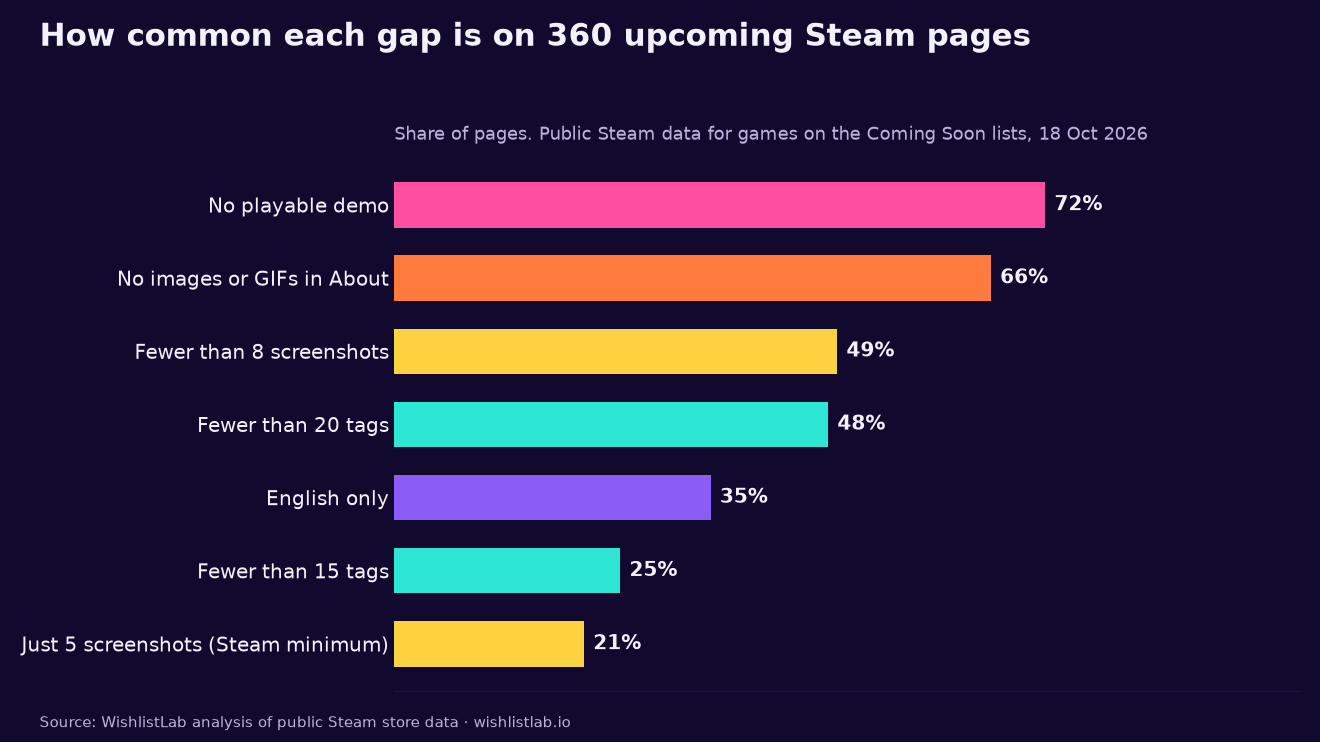
- 48% show fewer than the 20 tags Steam recommends. 25% show fewer than 15.
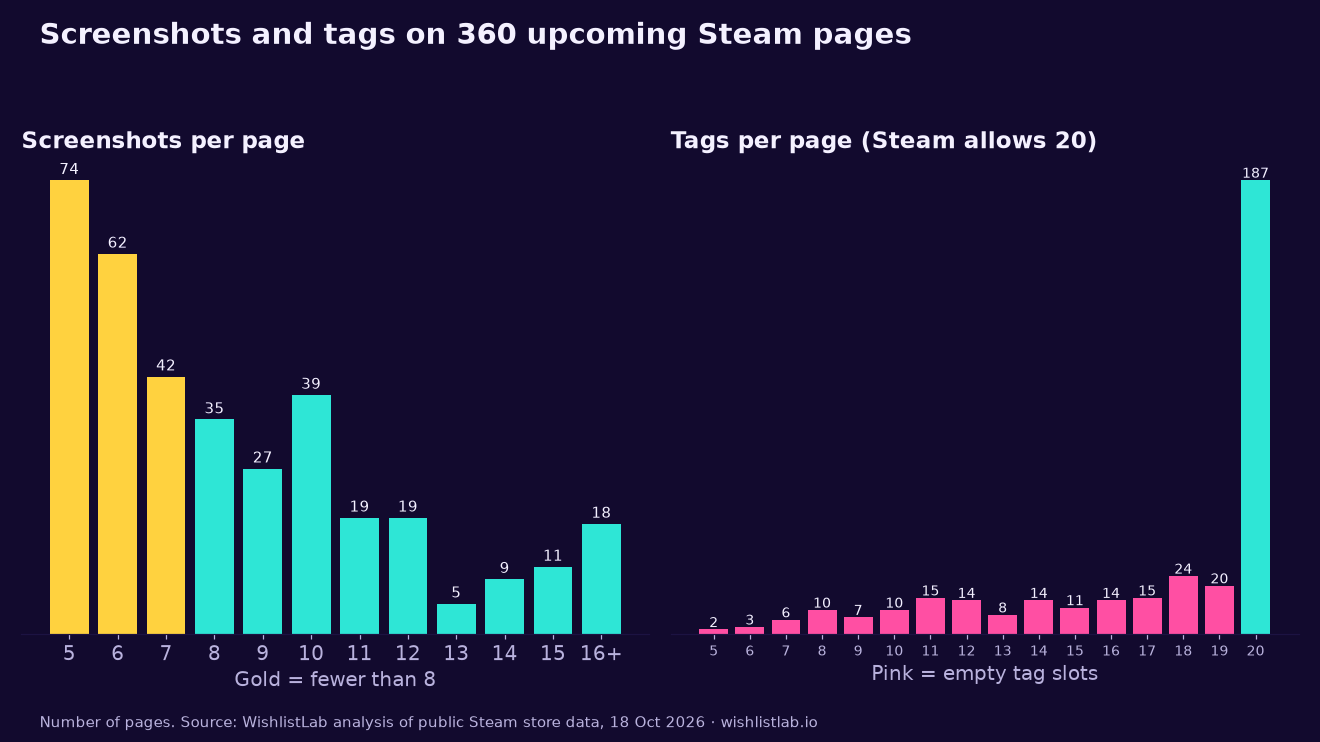
- 49% show fewer than 8 screenshots, and 21% show exactly 5, the minimum Steam asks for.
- 66% have no images or GIFs anywhere in their About section.
- 35% list English as their only language.
- 72% had no playable demo the day before Next Fest.
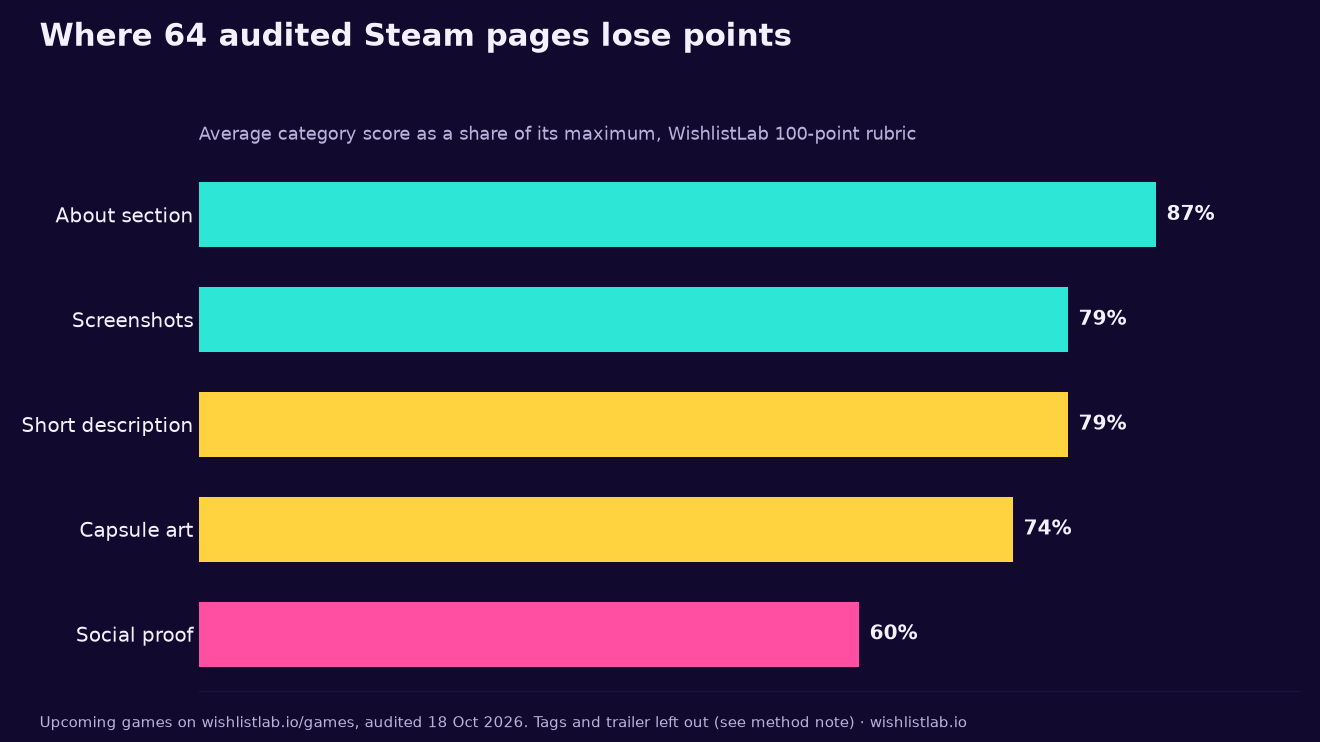
- In the 64 full audits, the average score was 78/100. Social proof (60% of available points) and capsule art (74%) lost the most points.
1. Nearly half of pages leave tag slots empty
Tags decide where Steam shows your game. Steam's own tag documentation says the top 20 tags determine which tag pages your game appears on, which games show up in "More Like This", and how Steam's recommendations match you to players. It also notes that some store filters use your first 15 tags.
Despite that, 48% of the pages we checked showed fewer than 20 tags, and one in four showed fewer than 15. Every empty slot is a missed chance to appear on another tag page or in another set of recommendations.
How to fix it
- Open the Tag Wizard (Store Presence, Edit Store Page, Basic Info, Tags) and fill all 20 slots.
- Put your most specific genre first. "Precision Platformer" tells Steam more than "Action".
- Move broad tags like "Indie" or "Singleplayer" to the bottom. Steam's documentation calls them low-information tags, and says very common tags like "Action" matter very little for recommendations.
- Look at 5 games your players also love and note which of their tags fit your game too.
- Publish the tags. Tag changes are published separately from the rest of the store page, so they're easy to forget.
2. Nearly half of pages show fewer than 8 screenshots
The median page had 8 screenshots. 74 pages, 21% of the sample, had exactly 5, which is the minimum. Nearly half had fewer than 8.
Screenshots are often the first thing a player sees after the capsule, and the first few also show when players hover over your game in lists. In our 64 full audits, putting the clearest gameplay screenshots first was one of the top 3 fixes for 53 games (83%).
How to fix it
- Aim for 8 to 10 screenshots, and make the first 4 your clearest gameplay moments.
- Each screenshot should show something different: the core loop, a big moment, progression, variety.
- Cut menus, logos and concept art from the first slots. Players want to see what they'll be doing.
- Check them as small thumbnails. If you can't tell what's happening, players can't either.
3. Two thirds of About sections are text only
66% of pages had no images or GIFs anywhere in their About section. The median About section had about 1,450 characters of text, and roughly a quarter had under 1,000.
The About section is where a curious player decides whether to wishlist. A wall of text is hard to scan, especially on a phone.
How to fix it
- Add a short GIF of your core loop near the top, then one every two or three paragraphs.
- Use image headers or bold lines to break the text into sections: what you do, what makes it different, key features.
- Lead with the hook, not the backstory. Lore can come further down.
- Keep feature bullets concrete. "40 hand-built levels" works better than "hours of content".
4. The short description is long enough, but the opening is buried
Length isn't the problem. The median short description used 235 of the 300 characters Steam allows, and only 9% used fewer than 150.
What goes first is the problem. In our 64 full audits, rewriting the short description was one of the top 3 fixes for 51 games (80%). Most of these pages already named their genre. The audit notes kept coming back to three things: a first sentence that runs long, a hook that arrives after the setting or story setup, and broad phrases like "unique" or "addictive".
How to fix it
- Put the genre and the hook in the first sentence: what kind of game it is, and what's different about it.
- Then say what the player does, using verbs: build, fight, explore, solve.
- Save the setting and story for the last sentence, if there's room.
- Cut words that don't help a player decide, like "unique", "addictive" or "immersive".
A simple formula: [Specific genre] where you [core action] to [goal], with [your twist].
5. Capsule art loses points for being hard to read when small
Capsule art averaged 74% of its available points in our audits, the second-weakest category. Almost every capsule note (60 of 64) was about how the logo and art read at the small sizes Steam uses in lists and search, and about half mentioned a busy or cluttered background.
How to fix it
- Shrink your capsule to the size it appears in search results and lists. If the logo blurs, simplify the background or make the logo bigger.
- Make sure one image says what kind of game it is: a character in action, a vehicle, a board, a monster.
- Use contrast between the logo and the background, not just colour.
6. One in three pages is English only
35% of pages listed only English. The median page supported 4 languages.
You don't have to localise the whole game to reach more players. Translating the store page text (the short description and About section) is a much smaller job, and it helps players who search and browse in their own language.
How to fix it
- Look at your Steamworks traffic or wishlist data by country, and start with the biggest non-English markets.
- Translate the short description first, then the About section.
- Use a native speaker to check it. A clumsy translation can hurt more than English.
7. Social proof is the weakest category, and most pages have no demo
Social proof was the lowest-scoring category in our audits, at 60% of available points. That's expected for unreleased games, because they don't have reviews yet. But only 28% of the 360 pages had a playable demo, even though Next Fest started the next day.
How to fix it
- If you can, ship a demo. It's one of the clearest pre-release signals you can give a player.
- Add press quotes, festival selections or awards near the top of the About section.
- Mention your community if it's real: Discord members, playtest numbers, a past game's reviews.
What the scores look like
Our 64 full audits averaged 78/100 (median 77, range 65 to 87). That's a top-end sample. These games were listed on our public pages after scoring 70 or more on an earlier automatic check, so the average upcoming page is likely to score lower.
Even so, the pattern held for good pages too. They lost the most points on social proof and capsule art, while About sections scored best.
A quick checklist before your next event
- Fill all 20 tag slots, most specific genre first, and publish them.
- Move your 4 clearest gameplay screenshots to the front, and get to at least 8.
- Add one GIF of your core loop near the top of the About section.
- Rewrite the first sentence of your short description so it starts with the genre and the hook.
- Check your capsule at search-result size.
- Translate your short description into your biggest non-English market's language.
How we got these numbers
- Public data sample (360 games): On 18 October 2026 we read the public Steam store data for the first 300 games on Steam's "Popular Coming Soon" search list and the first 300 on its "Coming Soon" list (360 unique games once duplicates were removed, all marked coming soon). Screenshot, trailer, language, demo and About section figures come from Steam's public app data. Tag counts come from each public store page, which shows up to 20 tags. Popular upcoming games make up most of the sample (300 of 360), so if anything these pages should be better prepared than average.
- Full audits (64 games): These are the upcoming games on wishlistlab.io/games, each audited on 18 October 2026 against WishlistLab's 100-point rubric (capsule, short description, trailer, screenshots, tags, About section, social proof). The overall scores include every category. The category chart leaves out tags, which the 360-page sample covers in more detail, and the trailer, because the audit counts trailers but doesn't watch them. The "top 3 fixes" figures count how often a fix appeared in each game's top 3.
- What we didn't do: We haven't named any individual game, and none of these figures come from private developer data.